Aging population problem due to the low birth rate in South Korea
Aging population problem due to the low birth rate in South Korea
October 15, 2024
Introduction
Have you ever heard Korea might disappear in the future? If it’s your first time hearing this information you will probably wonder, why. You might think ‘Korea has popular culture, famous idols, why would Korea disappear?’. Now let me tell you why. South Korea has an ageing population problem, due to the extremely low birth rate, the aging population problem is another serious problem in South Korea. As the birth rate decreases, the ageing population increases. In current society, a low birth rate is one of the main reasons why many countries are facing an aging population, especially in South Korea. There are economic problems due to the ageing population because, in current society, businesses usually don’t provide job opportunities for elder people. A low birth rate also leads to when the children grow up, they need to pay more taxes to serve older people. The seriousness of these problems must lead to social policy intervention.

Figure 1. Picture of senior citizens in South Korea
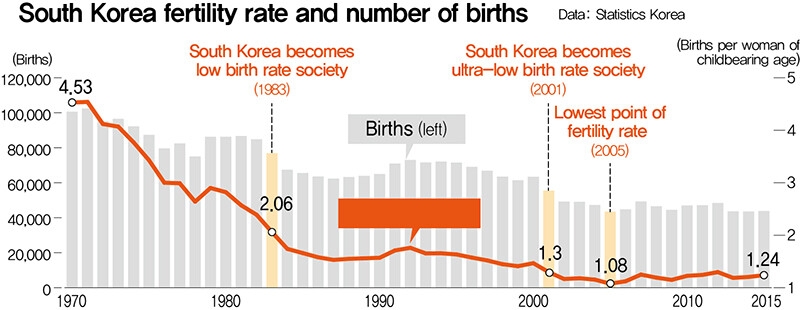
Figure 2. Graph of South Korea fertility rate and number of births
First, low fertility rate problem in South Korea is a crucial problem in South Korea.

Figure 3. Picture of empty baby bed in the Korean hospital
The low fertility rate is the cause of the ageing population and unbalanced population in current Korean society. According to Cho, in 2021 South Korean media published articles about natural decline in the nation’s population. Since 2002, the total fertility rate of South Korea has dropped below 1.3. In 2020, the number of births is lower than the number of deaths which means Korea faced a natural population decline. In addition to this problem, after COVID-19, the birth rate would decrease even more, and the death rate would increase (6). Cho also mentioned according to the survey, most Koreans especially people in their early 20s answered that being a parent is an invaluable thing in life. Due to the reality of Korean society, Korean people face a lot of problems in terms of finding jobs and having a stable life which leads them to have a hard time thinking about getting married and having a child (Cho 7). Personally, If I look at the married couples near me, there are tendency for people not to want to have kids due to various factors. Some couples think having kids can be a financial pressure or some couples think that having kids will not let them do what they want to do. Compared to the past, people’s perspective changes which leads to have low fertility rate in current society.
Second, the ageing population problem in South Korea is another major problem in South Korea.

Figure 4. Picture of old person in Korea collecting papers or plastics to get some money
The ageing population, another problem follows the ageing population problem which is elder workers. According to Lee, the ageing population problem is a serious issue compared to other countries and this problem leads to the economy problem in South Korea as well. According to the analysis, the results show that due to the population ageing problem, the labor participation of elder people increased (1). Since the aging population is a huge problem and as time goes on, businesses will have a hard time finding young workers. So, to prevent the labor problem in the future, it’s crucial for elder people to participate in labor. Also, it’s important to make sure to provide better conditions for elder people So, it’s important to make some policies or regulations for elder workers (Lee 15). If I look at current Korean society, first of all, there are a lot of elder people. They are not working due to the fewer job opportunities. Although, there are some jobs which are cleaning, cooking. Those are job opportunities that young people don’t want to do and tend to be physically hard for elder people.

Figure 5. Dink pet group
Due to the low fertility rate, it’s crucial to be aware of the seriousness of this problem, and the seriousness of this problem must lead to social policy intervention. According to the news also the Korean population and fertility rate have decreased over time. For example, I saw a news article. The news article claims that in current society, people don’t give birth which leads to a decrease rate in the total fertility rate. In that news article, it said the total fertility rate is below 1 which means there are a lot of married couples who don’t give birth at all (KBS 1). According to the analysis in the news article, it’s saying that Korea’s work culture makes it hard to balance work and family which makes women hard to give birth. Also, according to the analysis, people claim that it’s hard to use maternity leave due to social norms and pressure (KBS, 3). There are certain expressions in social network service which are the Dink group and Dink pet group. The dink group is married couples who are not giving birth because they think giving birth is unnecessary in their life. Dink pet group is raising dogs instead of babies (Seo 1). Figure 5 is an example of the Dink pet group. They don’t want to raise babies, so they tend to raise pets instead. There is stress, social pressure, and norms of raising children, which is a reason why South Korea has a low fertility rate. That’s why it’s crucial to be aware of the seriousness of this problem and the severity of this problem must lead to social policy intervention.
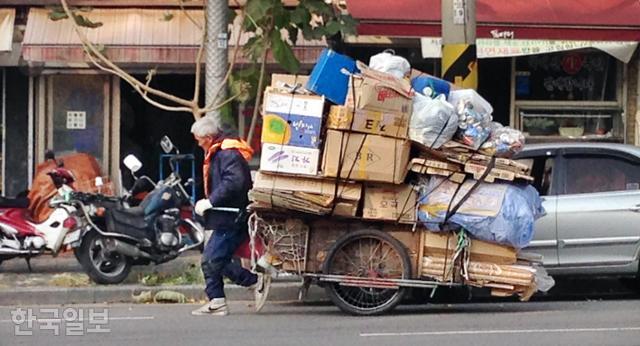
Figure 6. Old man collecting paper, recycling things to earn money
The problem of the ageing population should lead to social policy intervention as well. According to my personal experience, there are a lot of older people who want to work but hard to find job opportunities. Also, there are a lot of people who are struggling to maintain their life because of the financial problem. Like Figure 6, if you walk on the street, you can see old people who are collecting paper, plastic, and recycling things because you can sell them for a low price. Also, due to financial problems, there are a lot of elderly people who can’t get proper medical treatment or are not able to eat balanced meals. According to Kim, as the fertility rate decreases, there will be low consumption by younger people, which will lead to high consumption by the elderly (8). So, according to the current trend, it’s hard for elderly people to get job opportunities and this problem should lead to social policy intervention.
In conclusion, the Low fertility rate is a cause of the aging population and both problems are serious problems that we need to be aware of. South Korea has a lower than 1 total fertility rate which is a crucial problem that we need to think of and fix. Also, we need to think about social norms and stress that married couples receive about raising kids and giving birth. For the aging population problem, elderly people don’t get enough job opportunities or chances to do some activities. So, the seriousness of these problems must lead to social policy intervention.
Work cited
https://www.businesskorea.co.kr/news/articleView.html?idxno=51074 (figure 1)
https://english.hani.co.kr/arti/english_edition/e_national/758664.html (figure 2)
https://www.elfac.org/south-koreas-total-fertility-rate-hits-record-low-of-0-98-in-2018/ (figure 3)
https://koreaexpose.com/no-country-for-old-people/ (Figure 4)
https://cm.asiae.co.kr/article/2024010409175637406 (Figure 5)
https://www.hankookilbo.com/News/Read/A2020120311300001360 (Figure 6)
Cho, Kyung Ae. “Korea’s Low Birth Rate Issue and Policy Directions.” Korean Journal of Women Health Nursing, vol. 27, no. 1, 2021, pp. 6–9, https://doi.org/10.4069/kjwhn.2021.02.16.
Lee, Jaejoon. “Population Aging in Korea: Importance of Elderly Workers.” KDI Journal of Economic Policy, vol. 45, no. 2, 2023, pp. 51–69, https://doi.org/10.23895/kdijep.2023.45.2.51.
Kim, Hyun Kyung, and Sang-Hyop Lee. “The Effects of Population Aging on South Korea’s Economy: The National Transfer Accounts Approach.” The Journal of the Economics of Ageing, vol. 20, 2021, pp. 100340-, https://doi.org/10.1016/j.jeoa.2021.100340.
“아이 권하지 않는 사회…OECD가 본 한국 저출산 이유 [특파원 리포트].” KBS 뉴스, news.kbs.co.kr/news/pc/view/view.do?ncd=7805919
서정민. “[밀레니얼 트렌드 사전] 딩펫족.” 중앙일보, 14 Dec. 2022, www.joongang.co.kr/article/25125874. Accessed 5 Nov. 2024.
Starting off I would like to thank you for writing this entertaining blogpost as it helped learn a new problem people in South Korea are facing. South Korea’s low birth rate and aging population pose serious challenges that could affect the country’s future stability. An aging society increases economic strain, as fewer young people are available to support a growing elderly population. Addressing this issue requires targeted social policies to create a more balanced and sustainable demographic structure.
ReplyDeleteThis comment has been removed by the author.
ReplyDeleteThank you for your thoughtful blog post on South Korea’s demographic crisis. The topic is crucial, as the country’s low fertility rate and aging population impact not only the economy but also social sustainability. I learned a lot from your insights into cultural factors, such as the DINK and “DINK pet” groups, and the financial pressures leading many elderly individuals to work in low-paying, strenuous jobs. Your personal observations make the issue relatable, while quotes from scholars like Cho and Lee add credibility.To strengthen your argument, consider including examples from other countries like Japan, showing both successful and unsuccessful policy attempts. More recent statistics on Korea’s future workforce and healthcare demands could also highlight the urgency. The images you used are impactful, especially those illustrating elderly poverty and empty baby beds, which reinforce the issue’s gravity. Reading your post emphasizes the need for immediate policy intervention to sustain South Korea’s future.
ReplyDeleteThank you for writing this blog. You do a good job of analyzing the aging problem caused by the low birth rate in South Korea, and exploring how the demographic imbalance is having a profound impact on the Korean economy and society. You also use a lot of actual data and information to enhance the credibility of the article. It reveals a lot about what young people think about fertility, and it's enlightening.
ReplyDelete